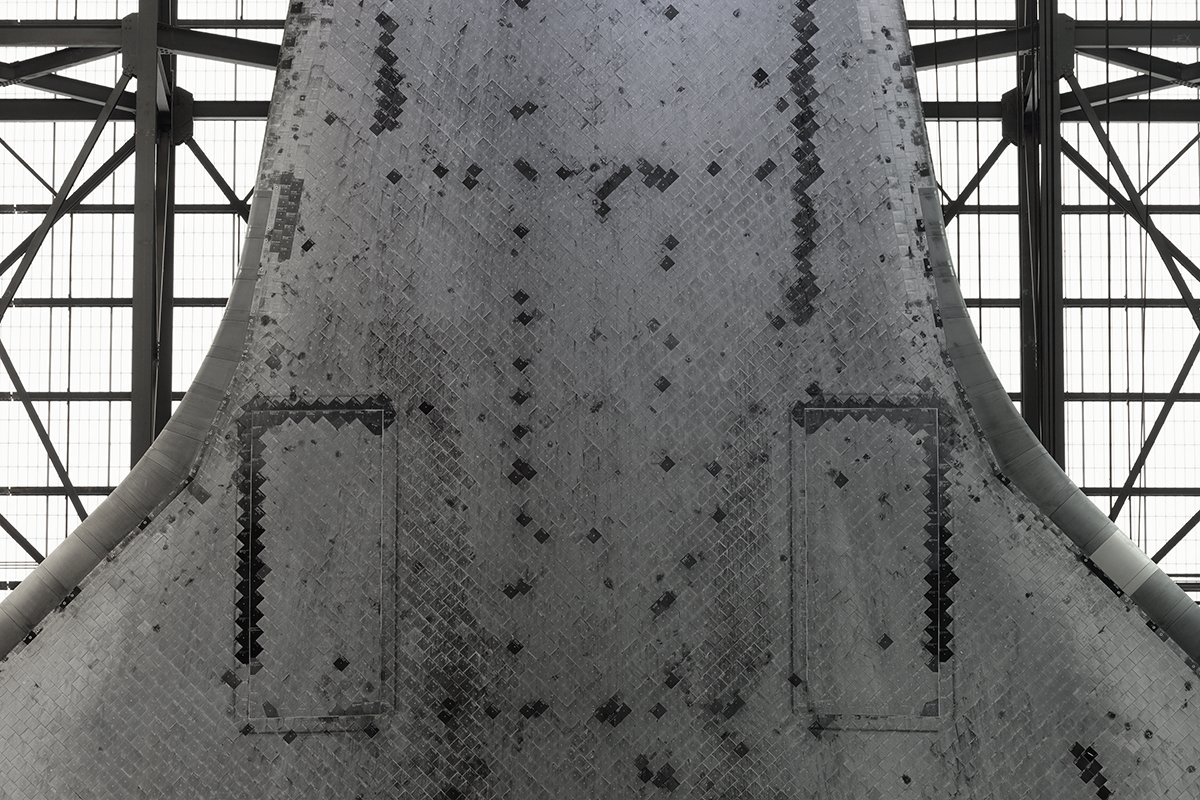
Belly view of Space Shuttle Endeavour, awaiting mating to the external tank for STS-134, while hanging in the transfer aisle of the Vehicle Assembly Building at NASA’s Kennedy Space Center in Florida.
Orbital Planes Gallery
Book: Orbital Planes: A Personal Vision of the Space Shuttle
Roland Miller’s Orbital Planes photographic project explores the Space Shuttle program by blending abstract and documentary styles. The images and the book Orbital Planes: A Personal Vision of the Space Shuttle, created from this work, offer a cohesive and detailed record of the program’s technology and infrastructure. Miller captures the complexity and beauty of the Space Shuttle orbiters, rockets, and support facilities.
The Space Shuttles are among the most photographed objects in the world, whether through industrial documentation, photojournalism, or amateur efforts. However, Orbital Planes aims to create images that not only capture the essence of the Space Shuttle experience but also explore the technology and culture in ways that official government or photojournalistic documentation of this program has not attempted.
Carsten Olsen, author and space book blogger, described my work as follows: “One of the most fascinating aspects of Orbital Planes: A Personal Vision of the Space Shuttle is the way Roland Miller visually deconstructs the immensely complex technology of human spaceflight. Rather than simply documenting the Space Shuttle as a complete machine, he breaks it apart into fragments — surfaces, textures, patterns, structures, and details — allowing the viewer to experience the orbiters in an entirely new way. Through this approach, the overwhelming complexity of aerospace engineering becomes surprisingly accessible and deeply human.”
Miller aims to provide sociological, historical, and artistic insights into the Space Shuttle era and to examine the possibilities for future space exploration through an abstract lens on these topics. By removing these subjects from their literal context, he can more readily investigate these themes. At the same time, this project remains, on one level, a documentary effort. To better explore the topic and engage viewers, Miller offers a foundational viewpoint by including some images with a more documentary style. The combination of abstract and documentary approaches allows him to connect with viewers more deeply and view the subject from a broader perspective.