White Point and Black Point Targets
Precision White Point and Black Point Targets
Once you have calibrated and profiled your monitor and profiled your printer, you need to systemize your printing by outputting white point and black point visual evaluation targets. By printing the Precision White and Black Point Targets through a color-managed workflow with the proper print settings, you will have the visual information needed to determine the appropriate white and black point settings for your image.
Visual Evaluation
Even with a calibrated and profiled system, you still need to make a visual evaluation of the white and black point settings. These settings are set using the six-step Tone System Color Correction Routine. A combination of factors requires this visual evaluation. Theoretically, the profiling process should handle highlight (white point) and shadow (black point) separation. However, spectrophotometers can differentiate values more precisely than the human vision system, and ink-jet printers are limited in how little or how much ink they can deliver precisely. Because of these factors, we need to visually place the white and black points. Black point compensation is thought to adjust the black point for varying media and color spaces, but testing has shown that it does not always do enough.

White Point Target 255 to 238 Black Point Target 10 to 26
This target is designed to cover most printers’ typical black and white points. The left side has 18 white point target values from 255 down to 238. The right side contains 17 black point target values from 10 to 26, plus an additional target value of 3 for confirmation or proper printing.
This target should be sufficient to determine the proper black and white points for most printer/media combinations.

Black Point Target 0 to 35
This target is designed to ensure the black point is properly defined on printers with lower black-point capabilities. The range from 0R 0G 0B to 35R 35G 35B will cover almost any printer's black-point capabilities.

WP/BP Test Image Target
The White Point/Black Point Test Image Target is designed to confirm the theoretical white and black points determined with the other targets.
How to Interpret The White and Black Point Targets (click here)
Human Vision
The average person can distinguish about 180 to 200 shades of gray. If I gave you 1000 gray paint chip samples, each differing slightly in value, and asked you to sort them into piles of like values (without telling you they were all different), you would sort them into about 180-200 piles. This explains why the magic number for digital images is 256 - 8 bits. 8-bit images (2 to the 8th power) have 256 value possibilities. A lower bit depth (2 to the 7th power = 128 values) will not provide enough values to satisfy the human vision system that the image is continuous in tone.

1000 paint chips, all different values.
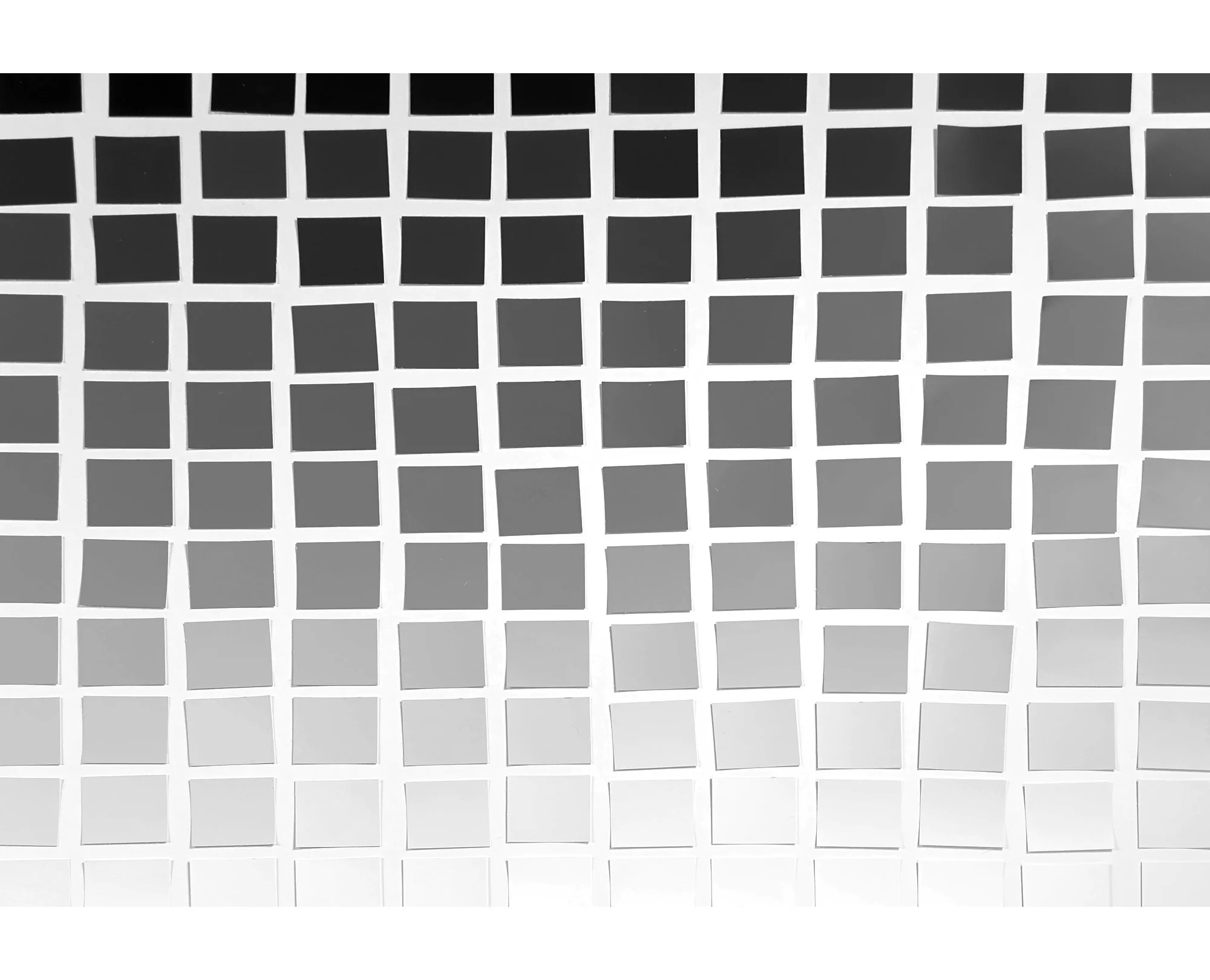
1000 paint chips sorted into 180-200 piles of “like” values.